publications
A comprehensive collection of academic publications organized by type and sorted chronologically.
Pre-Prints
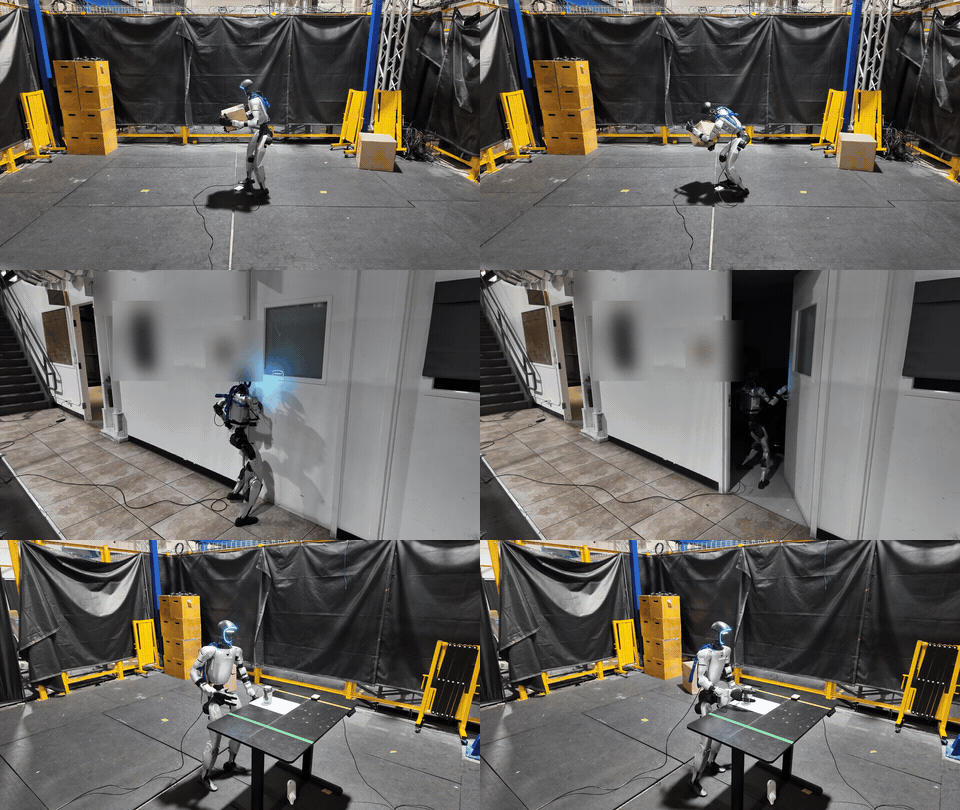
- Action-Aligned Latent Planning for Versatile Humanoid Loco-ManipulationYutang Lin, Guanya Shi, and C. Karen LiuarXiv, Oct 2026
FIBER plans in the executable, action-aligned latent space of a frozen behavioral foundation model. Latent policy projection maps independently acquired skill experts into this shared representation, enabling one perceptive planner trained entirely offline to perform box pickup, door opening, and object grasping. Adaptive-horizon BFM training supports precise interaction and extended whole-body behavior, with real-world transfer, skill chaining, and conditional steering on a Unitree G1.
- OmniClone: Engineering a Robust, All-Rounder Whole-Body Humanoid Teleoperation SystemYixuan Li*, Le Ma*, Yutang Lin*, and 8 more authorsarXiv, Mar 2026
OmniClone, a whole-body humanoid teleoperation system that achieves robust, high-fidelity multi-skill control on a single consumer GPU with modest data. We introduce OmniBench, a diagnostic benchmark that disentangles motion regimes and reveals failure modes overlooked by prior aggregate metrics, guiding an optimized training data recipe and system design. Through subject-agnostic retargeting and robust communication, OmniClone reduces MPJPE by over 66% while requiring significantly fewer resources. The system supports unified, control-source-agnostic operation—enabling teleoperation, motion playback, and VLA integration—and generalizes across operators with diverse body proportions, offering a scalable and practical foundation for humanoid control and learning.

Journal Articles
- AlphaChimp: Tracking and Behavior Recognition of ChimpanzeesXiaoxuan Ma*, Yutang Lin*, Yuan Xu, and 6 more authorsIJCV, Oct 2024
Understanding non-human primate behavior is crucial for improving animal welfare, modeling social behavior, and gaining insights into both distinctly human and shared behaviors. Despite recent advances in computer vision, automated analysis of primate behavior remains challenging due to the complexity of their social interactions and the lack of specialized algorithms. Existing methods often struggle with the nuanced behaviors and frequent occlusions characteristic of primate social dynamics. This study aims to develop an effective method for automated detection, tracking, and recognition of chimpanzee behaviors in video footage. Here we show that our proposed method, AlphaChimp, an end-to-end approach that simultaneously detects chimpanzee positions and estimates behavior categories from videos, significantly outperforms existing methods in behavior recognition. AlphaChimp achieves approximately 10% higher tracking accuracy and a 20% improvement in behavior recognition compared to state-of-the-art methods, particularly excelling in the recognition of social behaviors. This superior performance stems from AlphaChimp’s innovative architecture, which integrates temporal feature fusion with a Transformer-based self-attention mechanism, enabling more effective capture and interpretation of complex social interactions among chimpanzees. Our approach bridges the gap between computer vision and primatology, enhancing technical capabilities and deepening our understanding of primate communication and sociality. We release our code and models and hope this will facilitate future research in animal social dynamics. This work contributes to ethology, cognitive science, and artificial intelligence, offering new perspectives on social intelligence.

Conference Articles
- NeurIPS
 LessMimic: Versatile Humanoid–Object Interaction with Unified Distance Field RepresentationsYutang Lin*, Jieming Cui*, Yixuan Li, and 4 more authorsNeurIPS, Feb 2026
Versatile whole-body interaction between humanoid robots and everyday objects is a central goal of embodied intelligence. Existing methods often rely on motion-reference inputs or task-specific rewards, which couple each policy to particular motion scripts, object geometries, and contact timings. This coupling limits both geometric generalization and flexible interaction control, in which simple commands specify the motion intent and the object geometry determines how contact is executed. Here we present LessMimic, a framework for versatile humanoid–object interaction that requires no motion reference at inference. A single whole-body policy is steered by root-velocity commands and an interaction-type flag, and it is conditioned on a compact interaction representation built from short histories of surface distances and local surface directions queried from a Distance Field (DF). This geometry-conditioned interface lets the commands set the motion intent while contact behavior adapts to the local object geometry. Visual distillation further transfers the interface to egocentric depth, which yields a variant that deploys without Motion Capture (MoCap). Across object scales from 0.4× to 1.6×, LessMimic performs robustly on four interaction tasks (PickUp, SitStand, Push, and Carry), whereas motion-conditioned baselines degrade sharply away from the training scale. The same policy also composes heterogeneous skills in sequence, succeeding on 62.1% of five-task sequences and on 23.5% of sequences with 15 task instances. Grounding interaction control in local geometry rather than in motion references thus offers a path toward humanoid–object control that generalizes across geometries, follows simple commands, and composes heterogeneous skills.
- GapONet: Nonlinear Operator Learning for Bridging the Humanoid Sim-to-Real GapJieming Cui*, Zhenghao Qi*, Yutang Lin*, and 6 more authorsNeurIPS-W, Dec 2025
Sim-to-real transfer remains a central challenge for humanoid robots, where dynamics mismatches between simulation and hardware degrade control performance. We propose GapONet, a payload-conditioned nonlinear operator that maps simulation context functions to residual actions for hardware. We compile TWINS, a dataset of over 11,298 motion sequences, perform payload-aware system identification, and train GapONet to predict compensatory actions in real time. Our method keeps large gaps below 0.09% when tracking unseen motions, substantially outperforming competing approaches.
- COLA: Learning Human-Humanoid Coordination for Collaborative Object CarryingYushi Du*, Yixuan Li*, Baoxiong Jia*, Yutang Lin, and 4 more authorsICRA, Oct 2025
Human-humanoid collaboration shows significant promise for applications in healthcare, domestic assistance, and manufacturing. While compliant robot-human collaboration has been extensively developed for robotic arms, enabling compliant human-humanoid collaboration remains largely unexplored due to humanoids’ complex whole-body dynamics. In this paper, we propose a proprioception-only reinforcement learning approach, COLA, that combines leader and follower behaviors within a single policy. The model is trained in a closed-loop environment with dynamic object interactions to predict object motion patterns and human intentions implicitly, enabling compliant collaboration to maintain load balance through coordinated trajectory planning.
- CLONE: Holistic Closed-Loop Whole-Body Teleoperation for Long-Horizon Humanoid ControlYixuan Li*, Yutang Lin*, Jieming Cui, and 4 more authorsCoRL, Jun 2025
Humanoid teleoperation plays a vital role in demonstrating and collecting data for complex humanoid-scene interactions. However, current teleoperation systems face critical limitations: they decouple upper- and lower-body control to maintain stability, restricting natural coordination, and operate open-loop without real-time position feedback, leading to accumulated drift. The fundamental challenge is achieving precise, coordinated whole-body teleoperation over extended durations while maintaining accurate global positioning. Here we show that an MoE-based teleoperation system, CLONE, with closed-loop error correction enables unprecedented whole-body teleoperation fidelity, maintaining minimal positional drift over long-range trajectories using only head and hand tracking from an MR headset. Unlike previous methods that either sacrifice coordination for stability or suffer from unbounded drift, CLONE learns diverse motion skills while preventing tracking error accumulation through real-time feedback, enabling complex coordinated movements such as "picking up objects from the ground." These results establish a new milestone for whole-body humanoid teleoperation for long-horizon humanoid-scene interaction tasks.


